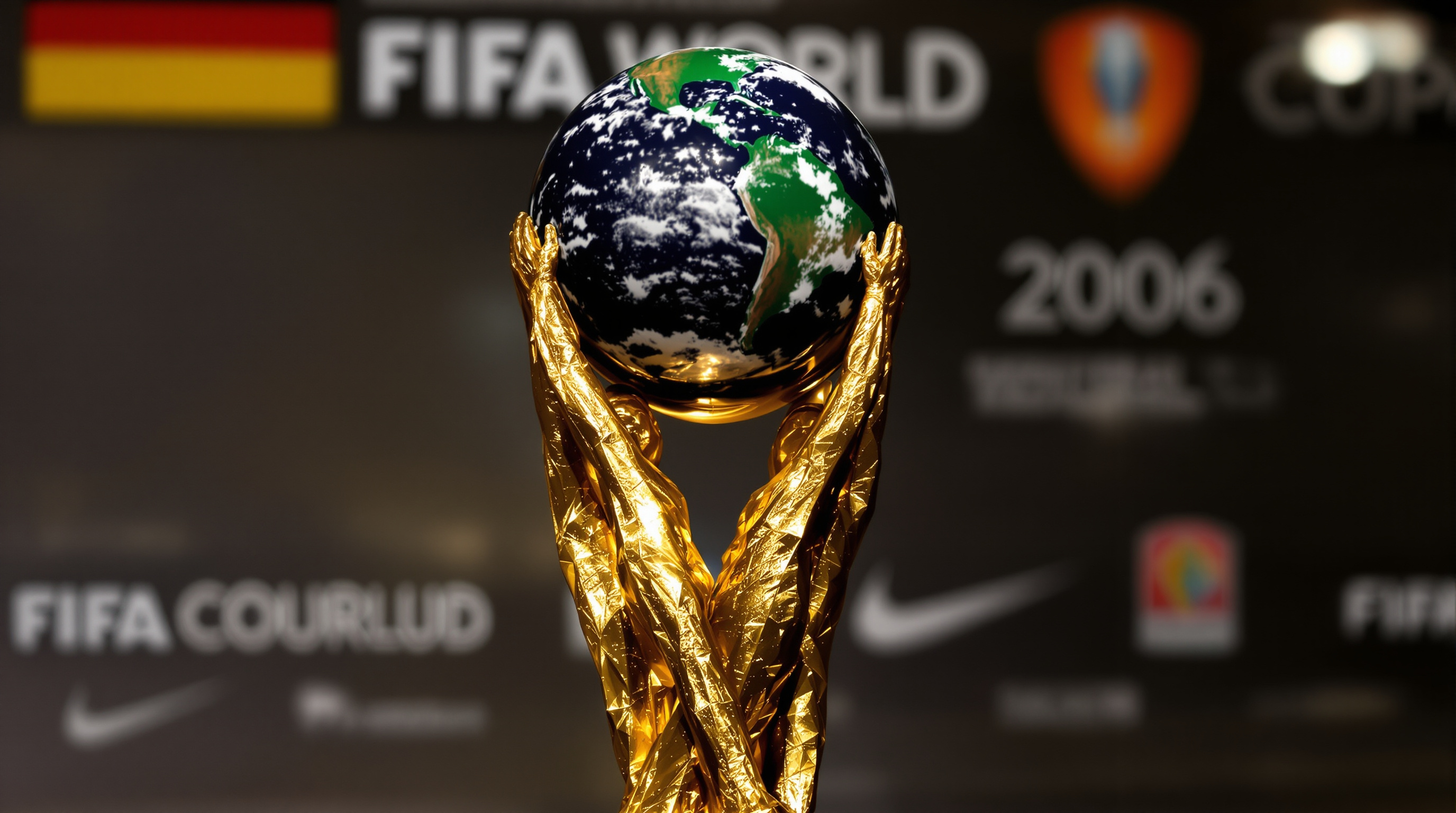
Hosting and Organization
The 2006 FIFA World Cup was the eighteenth edition of the FIFA World Cup, organized by the Federation Internationale de Football Association. Germany won the hosting rights on July 6, 2000, defeating South Africa by a single vote in a controversial final ballot.
The tournament featured 32 teams divided into eight groups of four, following the format established in 1998. The top two teams from each group advanced to the knockout rounds, consisting of the Round of 16, Quarter-finals, Semi-finals, and the Final.
Qualification
Qualification for the tournament saw 198 national teams compete for 32 spots. Germany qualified automatically as the host nation, while the defending champions Brazil earned their place through the South American qualifiers. European teams dominated the field with 14 representatives, while Africa sent five nations, Asia four, South America four (plus Brazil), CONCACAF four, and Oceania one.
Tournament Identity
The tournament's official mascot was Goleo VI, a lion wearing a Germany jersey, accompanied by a talking football named Pille. The official match ball, named '+Teamgeist,' represented the spirit of teamwork with its innovative 14-panel design - a departure from the traditional 32-panel construction.
Host Cities and Venues
Twelve German cities hosted matches: Berlin, Dortmund, Frankfurt, Gelsenkirchen, Hamburg, Hanover, Kaiserslautern, Cologne, Leipzig, Munich, Nuremberg, and Stuttgart. The Olympiastadion in Berlin hosted the final, while the opening match took place at the Allianz Arena in Munich.
Reception and Legacy
Germany's organization was widely praised, with FIFA President Sepp Blatter calling it "the best World Cup ever." The tournament attracted approximately 3.36 million spectators to the stadiums, with an additional cumulative television audience of over 26 billion viewers worldwide.
The total prize money reached $332 million, with the champions Italy receiving $20 million. The tournament also generated significant economic benefits for Germany, boosting tourism and international reputation.
Innovation and Officiating
Key innovations included the use of goal-line technology discussions (though not yet implemented), enhanced anti-doping protocols, and improved security measures following concerns about potential terrorist threats.
The referees for the tournament came from all six FIFA confederations, with 47 match officials selected from 32 countries. Horacio Elizondo of Argentina had the honor of officiating the final match.
Medical and Anti-Doping Protocols
The 2006 World Cup implemented some of the most rigorous anti-doping measures seen at any FIFA tournament. Every player was subject to pre-competition testing, and additional random testing took place throughout the group and knockout stages. FIFA partnered with the World Anti-Doping Agency (WADA) to ensure compliance with international standards, and no positive tests were ultimately confirmed during the tournament.
Medical teams at each venue were staffed with trauma specialists, physiotherapists, and sports medicine physicians. The tournament's medical infrastructure set a precedent for subsequent major competitions, with rapid pitch-side assessment protocols that would later evolve into the formal concussion substitution rules introduced in the 2020s.
The tournament's official song, "Time of Our Lives," was performed by Il Divo and Toni Braxton, while other musical moments included Shakira's "Hips Don't Lie" becoming synonymous with the tournament's festive atmosphere.
Learn more from the German Football Association (DFB) and FIFA official website.